
What you need to know! The current situation of dogs and cats taken to public health centers and how to help them

Are you aware of the current situation regarding dogs and cats taken into public health centers? In fact, over 80,000 dogs and cats are taken into public health centers every year.
"The owner requested the public health center to take them in."
"They got lost."
There are many reasons why dogs and cats are taken into public health centers.
What would happen if your beloved dog got lost?
If you're lucky, someone may rescue your pet and find it safe. However, in some cases, local public health centers or animal shelters may be contacted. It can be very worrying to think, "What if we can't find it?"
To help dogs and cats housed at public health centers, you can adopt them from the public health center or support animal protection activities.
This article details the current situation of dogs and cats housed at public health centers and how to help them. If you're thinking about adopting a dog or cat from a public health center or wanting to help, please read on.
What you need to know about the current situation of dogs and cats at animal shelters
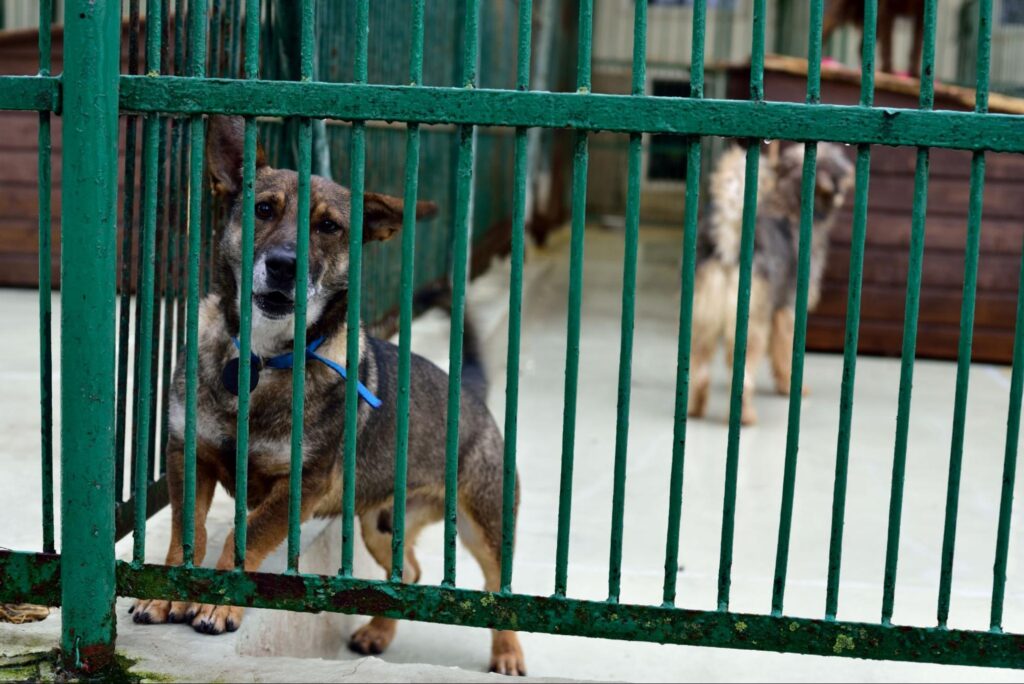
What are the reasons for dogs and cats being taken into public health centers? And how many lives can be saved?
From here, we will explain in detail the current situation of dogs and cats taken into public health centers.
Reasons for animals being taken to public health centers
The following types of animals are mainly taken into public health centers.
- Dog
- Cat
- Rabbit
- Budgerigar
- Ferret
- Hamster
And the reason these animals are being kept is because:
- Given up by owners who can no longer care for them
- Abandoned by owners
- Rescued as strays
Examples include:
Animals are taken into public health centers for a variety of reasons. However, did you know that abandoning an animal for personal reasons violates the "lifelong care" principle of the Act on Welfare and Management of Animals (Animal Welfare and Management Act)?
The Act on Welfare and Management of Animals (Animal Welfare and Management Act), enacted in 1973, stipulates that owners "must make every effort to properly care for the animal until the end of its life (lifelong care)."
For this reason, pet owners must strive to provide a good environment for their pets until the end of their lives. As the idea of lifelong care becomes more widespread, we can expect to see a reduction in the number of animals taken in by public health centers.
Furthermore, some public health centers and animal welfare centers are actively working to protect animals' lives and lead to adoption, and some areas have achieved zero euthanasia for rescued animals.
For example, Kanagawa Prefecture has maintained zero euthanasia for eight years and zero euthanasia for seven years, up until fiscal year 2020.
(Source: Kanagawa Prefecture Press Release)
Dogs and Cats Taken to Public Health Centers: A Look at the Numbers
Let's take a look at the number of dogs and cats taken to public health centers.
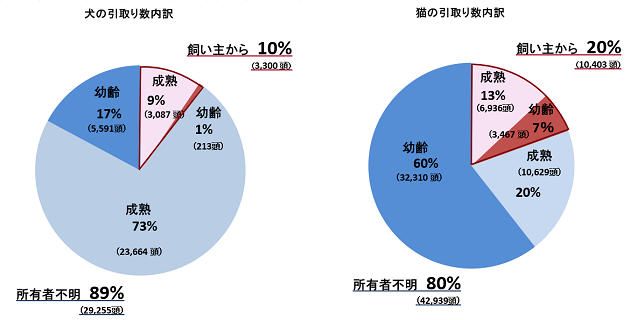
The following is the status of dog and cat collection and injured animal sheltering, as announced by the Ministry of the Environment's Natural Environment Bureau. (Applicable period: April 1, 2019 - March 31, 2020)
(Quote: Ministry of the Environment, Nature Conservation Bureau, "Dog and Cat Adoption andCurrent Status of Acquisition and Disposal of Injured Animals, etc.)
Looking at the numbers, the majority of dogs and cats taken into public health centers are unaccounted for. However, the percentage of owners who request the public health center to take in their pets is 10% of dogs and 20% of cats.
Overall, there are a large number of cats, especially young ones.
More than 10,000 lives saved
Next, let's look at the number of dogs and cats euthanized at animal shelters.
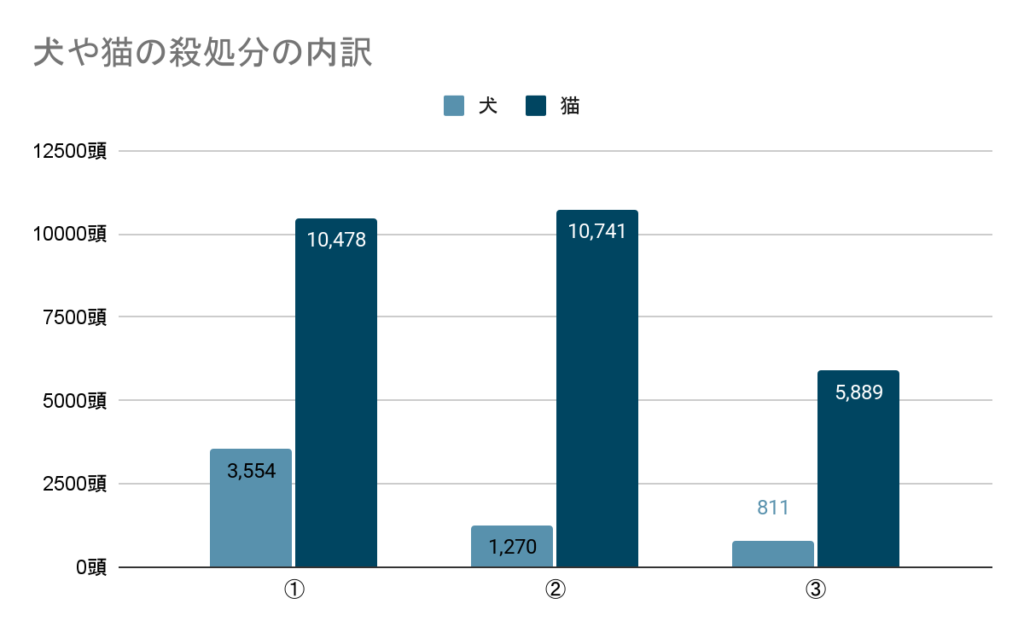
① It is not appropriate to adopt the pet (e.g., due to an incurable illness or aggressiveness).
② Disposal of animals other than those listed in ① (difficulty in finding a home or properly caring for them)
③ Death after adoption
(Source: Ministry of the Environment, Nature Conservation Bureau, "Status of collection of dogs and cats, and accommodation and disposal of injured animals, etc.")
Looking at the graph, we can see that cats are euthanized far more than dogs.
And the total number of dogs and cats in category ② who had no major health or care issues and could have been saved but were not was 12,011. Looking at the numbers again, we can see that more than 10,000 lives could have been saved.
How to Help Dogs and Cats in Government Facilities

Next, we'll explain in detail how to help dogs and cats housed in government facilities such as public health centers and animal welfare centers.
Basically, if you want to adopt a dog or cat housed in a government facility, you should first contact the facility. You'll then need to confirm that you meet the facility's adoption application requirements.
The most common conditions for adopting a pet are:
- The adopter must be an adult
- All family members must agree to keeping an animal
- Animal keeping is permitted in apartment complexes
These conditions vary depending on the facility, so be sure to check in advance.
Public Health Center Information
Information about dogs and cats being protected at local public health centers is available online.
For example, the Ministry of the Environment's Nature Conservation Bureau's "Animal Shelter Information Site" lists information on dogs and cats being cared for at public health centers across the country. It also introduces adoption events and initiatives run by each local government.
To adopt a dog or cat from a public health center, first find one you want to adopt. Then, contact your local public health center.
Adopting a dog or cat from a public health center generally follows the following steps.
1. Before adopting, attend a training session to learn about proper animal care.
2. Register your information to adopt a dog or cat.
3. Confirm compatibility with the dog or cat you wish to adopt and have an interview with a staff member.
4. Apply for adoption.
5. Adopt a dog or cat. (A home visit and check on the living conditions may be required.)
First, search for the dog or cat you want to adopt on an information website and contact the public health center.
Animal Protection Centers
Like public health centers, animal protection centers also publish information about rescued dogs and cats on the Ministry of the Environment's Nature Conservation Bureau's "Animal Shelter Information Site."
Even if you're adopting a dog or cat from an animal shelter, first find one you'd like to adopt. Then, if you find one you like, contact your local animal shelter.
The process for adopting a dog or cat from an animal shelter is the same as that for adopting from a public health center.
1. Before adopting, attend a training session that provides information on proper animal care.
2. Register the owner's information to adopt the dog or cat.
3. Check compatibility with the dog or cat you want to adopt and have an interview with a staff member.
4. Apply for adoption.
5. Adopt the dog or cat. (A home visit and check of the living environment may be conducted.)
Search for the dog or cat you want to adopt on an information website and contact your local animal protection center.
For those who want to know more about the current situation of protected animals

If you want to learn more about the current situation of protected animals, we recommend the following two activities.
・Read manga that explains the current situation of protected animals
・Support animal protection activities
Recommended manga that explains the current situation of protected animals
If you want to learn more about the current situation of protected animals, we recommend the manga "The Voice of the Tail."

(Source: Amazon)
"The Voice of the Tail" is a work that explores the dark side of the pet distribution industry. It depicts the dark side of the pet distribution industry, which has not been given much attention until now, such as where unsold animals from pet shops go and how they are treated.
By reading "The Voice of the Tail," you can learn about what is happening to animals in real life and the current situation of rescued animals.
Supporting Animal Protection Activities
Some of you may be worried about adopting a dog or cat from a shelter, but are unable to live with them because of the environment.
Adopting a dog or cat from a shelter is not the only way to help rescued animals. You can support animal protection activities by making donations to animal protection organizations or volunteering.
For example, the Japan Animal Welfare Society (Public Interest Incorporated Foundation) and the Animal Fund (Public Interest Incorporated Foundation) accept donations to support their dog and cat rescue efforts.
Some organizations also recruit volunteers to help with basic dog training at shelters. Volunteer recruitment information is often posted online.
Start by supporting animal protection efforts with whatever support you can within your means.
Summary
Until recently, most dogs and cats taken into animal shelters were euthanized. However, the number of dogs and cats euthanized is gradually decreasing.
This is likely the result of the efforts of animal shelters and volunteers, as well as the increasing number of people who want to adopt rescued dogs and cats.
On the other hand, there are also cases where owners ask animal shelters to take in their dogs and cats.
Lifestyles have changed during the COVID-19 pandemic, and more people are considering adopting rescued cats and dogs. If you are truly considering adopting a rescued cat or dog, it's important to understand the current situation and welcome them into your home, rather than just doing it on a whim.