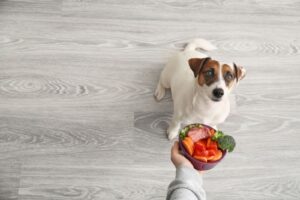


How often and how much should I feed my puppy?
While this varies depending on the breed, the puppy's constitution, and the living environment, it's important to know the approximate amount to fully support your puppy's healthy growth.
What is the recommended amount and frequency of feeding a puppy per day?

Puppies' digestive systems take time to develop. Therefore, feeding them more frequently per day than adult dogs is necessary, as eating too much at once can lead to indigestion.
Also, puppies are more susceptible to hypoglycemia than adult dogs, so you need to be careful not to underfeed them.
This is just a guideline, but it's recommended to feed them four times a day around 2 months of age, and three times a day from 3 to 5 months of age.
For very small breeds like Chihuahuas and toy poodles (also known as teacup poodles), it may be better to feed them four times a day, even at around 3 to 4 months of age.
If your puppy's stool becomes loose, it may be because it's being fed too much food at a time, causing indigestion. Conversely, if your puppy's stool is in small, hard chunks like lamb or rabbit stool, it's likely that it's not getting enough food or water. Adjust the amount and frequency of feeding based on the condition of your puppy's stool.
During their rapid growth period, puppies require the most calories of their lives.
Just as dieting during growth can only have a negative impact on a growing human child, it's not a good idea to feed your puppy only a small amount of food because they're said to be prone to obesity, because they've been spayed or neutered, or because you don't want them to grow larger than you'd like.
Until your puppy is about one year old, it's important to support the healthy development of bones, muscles, and other body tissues rather than worrying about them becoming obese.
Refer to the feeding amounts listed on the side and back of the dog food package based on age and weight, and make sure to feed your puppy an adequate amount of food.
A dog's calorie needs vary not only depending on age and weight, but also on the season and living environment.
In summer, dogs tend to be less active to conserve energy, resulting in less energy consumption. This reduces the calorie intake required. Conversely, in cold winters, more energy is needed to keep your dog warm.
Long walks or a day at dog daycare or kindergarten can also burn a lot of energy. In these cases, your puppy will need more calories.
Be flexible and adjust the amount of food you give your puppy.
It's said that a dog's energy needs are proportional to their body surface area relative to their weight.
The smaller a dog is, the greater its body surface area relative to its body weight, so small dogs need more nutritious food than large dogs.
This is why dog food is sold in different varieties based on breed size. Choose the right food for your dog.
There are formulas for calculating the calorie needs of dogs, but the calculation method is complicated and varies depending on whether the dog is small or large, so there's no need to worry too much about it.
We recommend that you continue to feed your puppy the recommended calorie intake, calculated by the manufacturer and listed on the food package. We also recommend that you regularly check with your veterinarian to ensure your puppy's weight and build are appropriate when you vaccinate them or take them to get preventative medications for heartworm, fleas, ticks, etc.
What happens if your puppy isn't getting the right food?
If a puppy overeats, mild symptoms include loose stools, while severe indigestion can lead to diarrhea and vomiting.
In fact, many breeders don't measure food for puppies until they reach 5 months of age, when their growth slows down, and instead feed them as much as they want as long as it doesn't cause loose stools. This is because not getting enough food can have a negative impact on their physical and mental development.
If a puppy becomes underweight, their immune system weakens, making them more susceptible to infections. Being too thin can also lead to impaired liver function.
Puppies have more water in their bodies than adult dogs, so it's fine for them to appear slightly chubby until around 4 months of age. If you feel your puppy's spine, ribs, and hip bones clearly visible, this is actually a sign that they're underweight, so be careful.
One reason puppies can lose weight without realizing it is because their owners don't know their dog's ideal weight.
Dog food packages list recommended amounts based on weight, but that weight is the ideal weight for that dog, so a 4kg serving of food labeled 4kg won't be enough for an already underweight 4kg puppy. To find out your dog's ideal weight, it's a good idea to have your veterinarian check it regularly at a veterinary clinic.
If you continue to feed your dog the same amount of food per day as initially recommended by the breeder or pet shop, it may end up being insufficient. Puppies are in their growth phase and grow rapidly. The amount of food you feed them must increase accordingly.
During puppyhood, be especially careful to avoid nutritional deficiencies caused by feeding them too little.
What to consider when choosing food for your puppy?
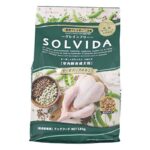
There are many different types of dog food on the market. When buying, choose one that says "complete food."
A complete food contains a balanced blend of essential vitamins and minerals for dogs, in addition to the three major nutrients: carbohydrates, fat, and protein.
Cheap dog food made with poor quality ingredients and excessive additives is said to cause diseases such as cancer, so choosing the highest quality dog food possible is important.
As a rough guide, choose food that costs over 1,000 yen per kg. If the same brand also has a "puppy" version, choose that until your dog is about one year old.
If your dog becomes accustomed to eating only the same type of dog food, it may not accept medical food or food provided at evacuation shelters during disasters.
It's said that it's a good idea to change dog food every time your dog finishes a bag, using about three different brands and protein sources.
Once opened, dog food gradually oxidizes, and as it oxidizes, its nutrients decrease. Eating it can also cause diarrhea, vomiting, and abdominal pain. Furthermore, as oxidation progresses, it becomes more toxic, leading to symptoms such as arteriosclerosis, myocardial infarction, and impaired liver function. Therefore, once opened, use the entire bag within one month.
How do I soak my puppy's food? How long should I soak it?
Soaking dog food in hot water can destroy the nutrients.
Therefore, it's best to soak it slowly over time in lukewarm or room-temperature water. Also, avoid using mineral water when soaking. Dogs don't need as many minerals as humans, so ingesting too many can lead to diseases like urinary stones.
If your pet's baby teeth haven't yet fully erupted, soften the food by pressing it with your finger until no hard core remains. As baby teeth gradually emerge, it's fine if a small core remains.
Digestive function and chewing ability development vary from individual to individual, so it's difficult to generalize, but once your pet turns 4 months old, it's generally not necessary to soften the food.
Summary

Puppies need the most calories of their lives, so make sure to feed them a diet appropriate for that stage.
Check your puppy's ideal weight regularly at the veterinarian, take care not to let them become underweight, and properly manage their diet to promote healthy growth.



![[Choosing dog food for health] 5 recommended low-fat dog foods](https://with-my-dog.com/wp-content/uploads/2022/07/image4-4-150x150.png)