
Have you ever wondered, "My dog sleeps all the time. Is it normal for him to sleep this much?"
"My neighbor's dog doesn't seem to sleep much. How much sleep do dogs actually need?"
Have you ever wondered something like this?
For adults, the required amount of sleep is thought to be 6-8 hours.
What about dogs?
Depending on the breed and personality, some dogs sleep continuously without noticing their owner's presence, while others stay awake throughout the night to accommodate their owner's needs. Sleeping times and timing vary. While the amount of sleep a dog gets varies depending on their age, it's generally believed to be more than half the day, between 12 and 18 hours.
Dogs sleep much longer than humans.
This article summarizes dog sleep, including why dogs sleep so much, how much sleep is normal, average sleep time, and sleep environment.
What Sleep Means to Dogs?

For dogs, sleep is important for restoring energy, just like it is for humans.
When dogs were still wild animals, they had the habit of conserving their energy by sleeping outside of hunting hours, and it is said that this habit remains to this day.
For dogs, sleep helps to consolidate memories of various events, such as fun experiences and stressful experiences during the day, and helps to recover from brain fatigue.
Even if your dog is happy and energetic after you come home at night and shows no signs of sleep, it's usually nothing to worry about, as he's sleeping well during the day.
However, if your dog seems unable to sleep day or night, you'll need to find ways to help him sleep.
Average Sleep Time for Dogs
The amount of sleep a dog needs varies depending on its age and breed.
Let's take a look at the average amount of sleep a dog needs and what is considered normal.
Longer Sleep Than Humans
The amount of sleep a dog needs varies depending on its age as follows:
| Age | Daily Sleeping Hours | Notes |
| Puppy (0-1 year old) | 18-20 hours | Highly active and consumes a lot of energy, so they spend most of the day sleeping |
| Adult Dog (1-7 years old) | 12-15 hours | Sleep about half the day |
| Senior Dog (8 years old and up) | 18-19 hours | Sleep most of the day, as they take longer to recover from fatigue |
Puppies and senior dogs sleep for about the same amount of time per day, but the reasons for their long sleep periods are slightly different.
Puppies run around energetically while awake. They even play with toys with all their might, destroying them.
With all that activity, it's not surprising that they sleep and recover when not playing.
Senior dogs' physical strength declines with age and takes longer to recover.
If you walk them for the same amount of time as an adult, it will take longer for them to recover, so they need to sleep more. Even after eating, digestion requires energy. They use energy to do everything and then recover with sleep, a cycle that repeats.
The reason dogs sleep so long is because of their sleep cycle.
Like humans, dogs alternate between REM (light sleep) and non-REM (deep sleep).
However, the proportion of these cycles is quite different between humans and dogs.
In humans, non-REM sleep accounts for about 75% of total sleep time, and REM sleep accounts for 25%.
However, dogs are the opposite of humans, with about 20% of their sleep being non-REM and 80% being REM.
The sleep cycles of humans and dogs are completely opposite.
This means that most of a dog's sleep is REM, a shallow sleep, so they need to sleep for long periods of time.
This is why even the slightest noise can wake a dog.
Differences by Body Size
Sleep time also varies depending on the breed and size of the dog.
Large dogs tend to sleep longer than small and medium-sized dogs because their larger bodies require more energy and require more time to recover.
There's also a theory that hunting breeds tend to sleep less.
Three Keys to Improving Sleep Quality
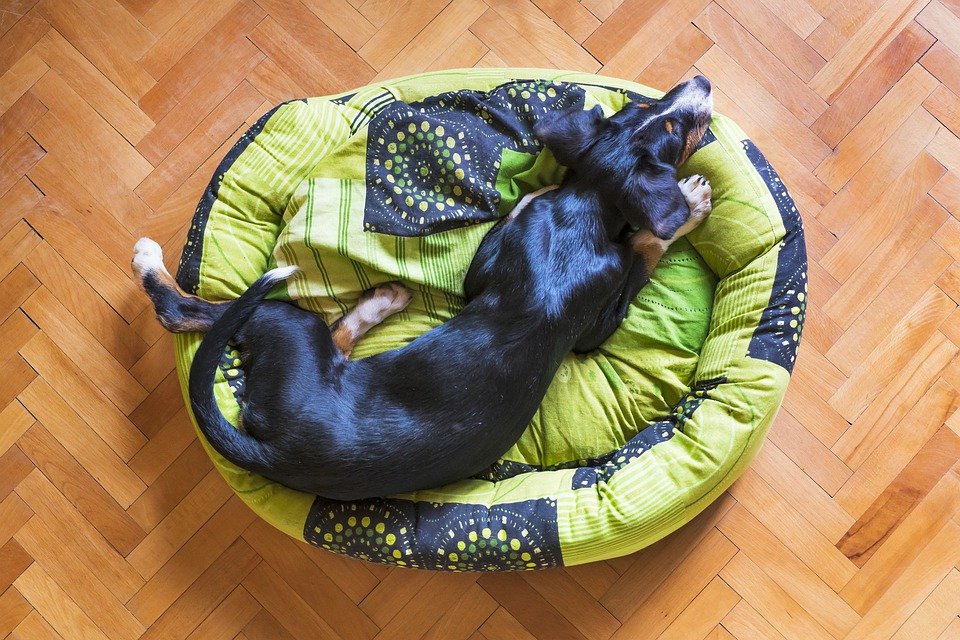
Just like humans, poor sleep quality or insufficient sleep can cause stress and potentially harm your dog's health. It's your responsibility as a dog owner to create an environment where your dog can feel safe and get enough sleep.
Try the following to improve your dog's sleep quality:
Provide a Dog Bed
In the days when it was common to keep dogs outside, doghouses were provided. The image of a dog sleeping in a doghouse evokes the image of a home with a dog from the Showa era.
In fact, dogs find it more comfortable to sleep in a dark, confined space, making a doghouse an ideal sleeping place.
In today's world, where most dogs are kept indoors, flooring and cage floors can be hard, and dogs that sleep for long periods of time can develop bedsores.
Large dogs are also heavier, putting a greater strain on their bodies.
Senior dogs sleep for long periods of time and may not be able to roll over, so it's a good idea to provide them with a bed with good cushioning.
Dogs generally like soft and fluffy places, so even if you don't have a dedicated bed, you can use an old blanket or bath towel as a substitute.
In this case, use a bed made of breathable material in the summer and one with good insulation in the winter.
Also, dogs are not good at regulating their body temperature, so room temperature control is also important.
Prepare a suitable sleeping environment
Designate a sleeping area for your dog so that he recognizes it as his sleeping spot.
The following places are not suitable for sleeping:
- Places with heavy foot traffic, such as near hallways or doors
- Places directly exposed to air conditioning
- Near entrances or windows where outside noise and voices are a concern
It's generally best to set up a sleeping area in a quiet and calm place.
If you're creating a sleeping area inside a cage or crate, it's also important to place the litter box away from the sleeping area.
One of the vestiges of their wild life is that dogs don't defecate near their sleeping areas.
Placing a litter box too close to their sleeping area can lead to accidents, so try to place it as far away as possible.
While it's basic to place a sleeping area in a calm location, dogs can become anxious and unable to sleep if they can't sense their owner's presence, so the ideal sleeping area is a calm place where they can sense their owner's presence.
Provide Moderate Exercise
Providing moderate exercise during the day, such as walking and playing with your dog, can help relieve stress and promote restful sleep.
Insufficient walk time can lead to insufficient exercise and poor sleep, so be sure to provide the necessary walk time for your dog, depending on its breed.
Things to consider if you sleep too much or too little
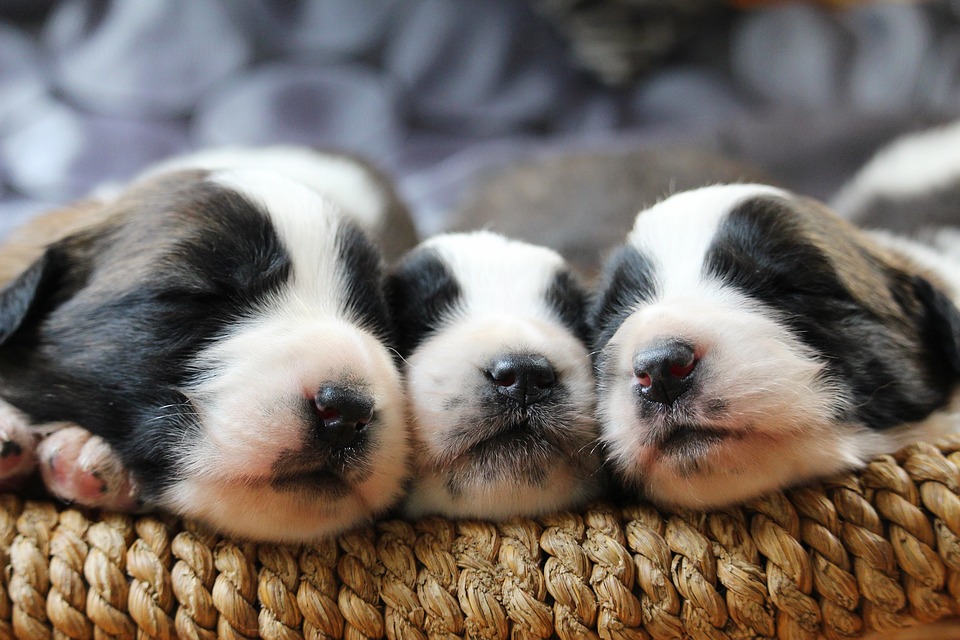
Lack of sleep has many drawbacks, but what about too much?
There are some things you need to be careful about when sleeping longer or shorter than average.
Longer-than-average sleep
Generally, there aren't many problems.
However, if your pet sleeps most of the day, or even for an excessive amount of time, it may be ill.
- Hypothyroidism
- Diabetes
- Injury
Other conditions may also be the cause, so it's best to consult your veterinarian.
Sleep duration shorter than average
If your dog won't sleep, it's not a big deal as long as he has an appetite and is in good spirits.
However, if he doesn't sleep for several days or if he loses his appetite, you should be concerned.
Observe your dog carefully for signs of illness or injury.
Possible reasons for your dog not sleeping include:
- Injured and in pain, unable to sleep
- Dermatitis, causing itching and unable to sleep
- Stomach pain after swallowing a foreign object, causing unable to sleep, etc.
In either case, we recommend an early medical examination.
If your pet is not only not sleeping, but also has a decreased appetite and is lacking in energy, this could be a sign of changes in their internal organs, such as heart or kidney disease. If you suspect your pet is not getting enough sleep, be sure to pay attention to other areas as well.
Summary
For dogs, sleep duration is a barometer of health, so getting adequate sleep is important for your dog's health.
A dog's sleep duration varies slightly depending on its age. It's important to understand the appropriate amount of sleep for each age group, and if your dog's sleep duration is consistently too long or too short, we recommend consulting a veterinarian.
Dogs spend a lot of time sleeping, so it's important to provide them with a comfortable sleeping environment, such as a comfortable bed and an optimal room temperature.
A comfortable room temperature varies slightly depending on the breed and the season, but it should be set between 20 and 26°C.
The length of sleep ultimately affects your dog's lifespan. Make sure to create a stress-free, comfortable sleeping environment.















![[Latest] French Dog Names: A Guide to Cool and Stylish Names](https://with-my-dog.com/wp-content/uploads/2022/04/image1-300x200.jpg)