
Owning a dog means training it. What do you imagine when you hear the word "training"?
For example, stopping unnecessary barking and correcting biting habits... There are many ways to train a dog, but toilet training is particularly important.
If your dog frequently soils the house with urine and feces, cleaning can become a burden.
Even when you go out with your dog, you're always worried about accidents.
However, owners aren't the only ones who suffer when their dog isn't toilet trained. Dogs also need a safe environment where they can relieve themselves.
If your dog is trained to always go outside, you may have to take them for walks even on bad weather, or they may have to hold their bladder for long periods of time if you're not feeling well.
Furthermore, if your dog is unable to go outside due to illness, they may end up holding their bladder for too long and develop cystitis.
When you bring your dog home, make sure to properly toilet train it. This is a key point for ensuring a comfortable life for both you and your dog.
Is potty training okay for adult dogs?
When it comes to toilet training, most guides focus on puppies. So, how should you train adult dogs?
The bottom line is that, just like puppies, adult dogs can master potty training.
The key is to praise them when they succeed, as discussed later in this column.
Adult dogs defecate less frequently than puppies, so the number of times they need to be potty trained will inevitably be reduced. It may take some time for them to master the technique, but take your time and keep training them patiently.
First, let's get ready! Where should it be placed? What kind of seat should it be?
It's best to initially place the litter box inside the crate.Once your dog is fully potty trained and has grown into an adult, place it in a corner of the room or away from resting areas like the crate. This will create a comfortable toilet environment where your dog can defecate calmly.
If the size is too small, it will be difficult for your dog to defecate.
The general rule of thumb is that the toilet should be about 0.5 times larger than the length of the body. It should be large enough for the body to fit snugly, with enough room for all four legs.
The larger the litter box, the more difficult it becomes to deal with toilet paper. Large toilet paper requires the entire surface to be replaced even if just a small area is soiled, which can be time-consuming and wasteful.
In such cases, we recommend using several regular-sized toilet paper sheets side by side to cover the entire area. If you're concerned about urine leaking through the gap between the sheets, you can place another sheet underneath.
When changing sheets, replace only the soiled ones to reduce waste and make maintenance easier.
When you bring your dog home, start potty training right away!
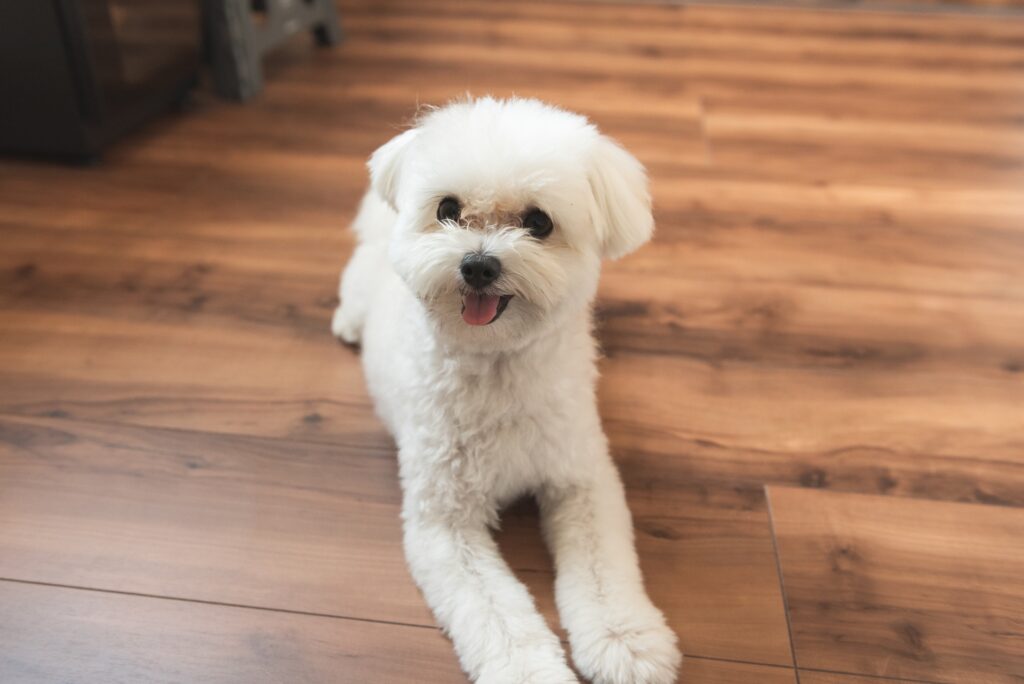
【Toilet Training】How Dogs Learn to Use the Toilet!
First of all, how do dogs learn where the toilet is?
Puppies often defecate frequently, sometimes as many as 20 times a day. As they repeatedly defecate, it's important to praise them when they do it successfully. Conversely, don't scold them when they fail. By accumulating memories of praise, your dog will learn where the toilet is.
[Toilet Training] What are the steps for toilet training?
These are the three basic steps in toilet training.
① Praise your dog if it defecates in the correct place.
② Guide your dog to avoid defecation in the wrong place.
③ Do not scold your dog if it defecates in the wrong place.
① Praise your dog if it defecates in the correct place.
When your dog defecates in the correct place, such as on the toilet sheet, be sure to praise him! Praise helps your dog learn that this is the correct way to do things.
The key to praising your dog is to react strongly. Puppies won't understand that they've been praised just by being petted. Some dogs don't like being petted. Therefore, it's a good idea to use sound to communicate your praise. Clap your hands, or say things like "Good job!" or "Great job! You did it!" with a smile, perhaps a little exaggeratedly. Dogs are sensitive to their owner's facial expressions and tone of voice. Dogs also enjoy being let out of their cage to play, and they realize they've been praised. However, as explained later, it's a good idea to return your dog to its crate after about 10 minutes.
If your dog defecates in the correct place, praise him profusely to solidify it as a positive memory.
② Guide your dog to avoid defecation in the wrong place.
Returning your dog to its crate before it defecates in the wrong place reduces the chances of failure.
Defecation in the wrong place, such as somewhere other than the toilet sheet, can cause your dog to become confused about the correct toilet location. To firmly establish the correct toileting location, owners need to encourage their puppies to do so as much as possible.
Puppies tend to defecate more frequently than you might expect. Even after defecation, if they are active and playing, they may defecate again within 10 minutes. Therefore, aim to limit playtime to within 10 minutes.
Even after feeding, dogs need to defecate. When playing after a meal, it's a good idea to check that they have defecate before letting them out of the cage.
3. Don't scold them if they defecate in the wrong place.
If your dog defecates in the wrong place, some people think that scolding them will discipline them, but this is counterproductive. Sometimes, the memory of being scolded can lead to them defecate in secret.
If your dog is about to defecate in the wrong place, such as outside the cage, return him to his cage immediately. Dogs will stop defecation if they are startled by being picked up, so move him quickly and have him defecate on a toilet sheet.
If you can't get there in time, clean up quickly without scolding him.
Use the golden rule of "praise, don't scold" when potty training!
Be patient and have fun... training is one of the joys of living with a dog!
Toilet training is the first thing you do after bringing your dog home. You may feel frustrated if it doesn't go well, but don't scold. It takes time to develop a habit.
Training is one of the joys of living with a dog. As you communicate with your dog, you'll begin to see its unique characteristics. Take your time to get to know your dog and enjoy potty training it as a good partner for the rest of your life!






![[Dog Earwax] Detailed explanation of Malassezia and ear cleaning](https://with-my-dog.com/wp-content/uploads/2021/10/girl-gf2eb2c5be_1920-150x150.jpg)

![[Popular dog food rankings] Recommended dog food and how to choose it](https://with-my-dog.com/wp-content/uploads/2021/10/入れ替え_5枚目-300x200.jpeg)